Last updated: October 24, 2026
Quick answer: in most cases, a sewage backup source can be narrowed to one of three places: a branch line, the building sewer, or the municipal sewer. This guide to Sewage backup causes and source tracing — The Complete Guide shows how to trace the source quickly enough to stop more contamination, protect the structure, and tell the right party whose pipe likely failed.
Key takeaways
- The first question is not “How do I clean it?” It is “Where did it enter, and whose line is responsible?”
- Most backups trace to a clog, root intrusion, collapsed pipe, grease buildup, a blocked vent, or a surcharge in the public sewer.
- The lowest drain fixtures usually show the problem first: basement floor drains, tubs, showers, and first-floor toilets.
- Source tracing depends on patterns, not guesses: one fixture versus multiple fixtures, one side of the building versus the whole house, and whether neighboring properties have symptoms too.
- A camera inspection, cleanout check, and manhole observation are the clearest ways to separate a private-line issue from a municipal one.
- If wastewater is coming up through multiple fixtures at once, the line is blocked hard enough that normal use should stop immediately.
- A plumber can clear a private blockage; a city sewer surcharge needs the utility or municipality involved.
- This guide is for homeowners, landlords, and property managers. It is not a substitute for a licensed plumber, a sewer specialist, or local public-health direction when contamination is active.
What a sewage backup usually means
A sewage backup means wastewater cannot move forward through the drainage system and is pushing backward through the easiest opening. That opening is often a basement floor drain, a shower pan, a tub, or the lowest toilet in the building. The failure point may be a small clog in a branch line or a full blockage in the building sewer, the line that runs from the property to the municipal main.
The key detail is direction. A normal drain problem slows one fixture. A sewage backup involves system pressure, and pressure spreads. If a basement toilet bubbles when upstairs laundry drains, or a shower backs up when a washing machine pumps out, the problem is usually downstream of both fixtures. That pattern matters more than the odor alone.
Because of that, a generic article gets this wrong by treating every drain overflow as the same event. It is not the same event, and a professional should trace it before anyone assumes the cause. A kitchen sink clog, a blocked roof vent, and a sewer main surcharge can all cause drainage trouble, but they do not point to the same repair or the same responsible party. A roof vent issue may show up as gurgling and slow drainage. A building sewer obstruction produces multiple fixtures reacting together. A municipal surcharge can push sewage into several connected properties after heavy rain or a street-side blockage.
If the backup includes solids, toilet paper, or dark wastewater, the source is often the sanitary drainage path, not a clean-water line. A professional should confirm that before work starts. That sounds obvious, but it prevents wasted time. A water supply leak is a plumbing problem. A sewage backup is a wastewater conveyance problem. Those are different systems, different hazards, and usually different responders.
For general health guidance on sewage exposure, the Centers for Disease Control and Prevention has a useful overview of cleanup and safety precautions, and the U.S. Environmental Protection Agency’s page on sanitary sewer overflows explains how system failures affect properties. Those agencies are not a substitute for a local plumber, but they anchor the basic risk picture: sewage is a contamination event, not a cosmetic nuisance.
Which signs point to the source of the backup?
The source is usually the lowest failed segment in the chain, and the symptom pattern tells you where that segment sits. If one sink is slow, the problem is probably local. If multiple fixtures on the same level fail together, the branch line or main line is more likely. If the whole house reacts, the building sewer or municipal sewer climbs to the top of the list.
The most useful clues are physical and immediate:
- One fixture only: A clog in that trap, trap arm, or branch line.
- Several fixtures in one bathroom group: A shared branch line or venting issue.
- Toilet plus tub or floor drain backing up: A main line blockage downstream of that group.
- Basement drain backing up first: The lowest cleanout or the building sewer is involved.
- Gurgling from distant fixtures: Air displacement from a restriction in the line.
- Backup after heavy rain: Possible inflow and infiltration, a municipal surcharge, or a failed private sewer with groundwater intrusion.
- Neighboring homes affected too: The public main is now a serious suspect.
A single slow drain does not prove a sewer backup. A backup needs a place to relieve pressure, and that pressure travels in predictable ways. In a multi-story home, the lowest opening often fails before the upper bathrooms do. In a slab-on-grade house, the first sign may be a floor drain or laundry standpipe. In a commercial building, a shared grease-affected line can produce symptoms in restrooms and utility sinks at the same time.
The timing matters as much as the fixture count. If the issue starts right after a guest flushes a toilet, runs a dishwasher, or drains a washing machine, the line may still carry flow, but only until a specific volume hits a blockage. If the backup appears during rain but not during dry weather, check whether stormwater and sanitary sewer systems are connected illegally or whether the municipal sewer is overloaded.
A camera inspection changes the guesswork into evidence. A plumber can run a sewer camera from a cleanout and look for root intrusion, offset pipe joints, grease, standing water, a belly in the line, or a full obstruction. A camera will not fix the pipe by itself, but it shows whether the line is blocked by a wad of paper and grease, a root mass, or a broken pipe segment. That is the point of source tracing: not just “there is a backup,” but “here is where flow stops.”
Sewage backup causes you can actually distinguish
The cause usually falls into one of six buckets, and each leaves a different trace. That distinction matters because a hydro-jetter, auger, root cutter, or pipe replacement solves different failures.
1) Grease and solids buildup
This is common in kitchen-connected lines and in buildings where fats, wipes, and paper products go down toilets or sinks. The symptom is gradual narrowing: drains get slow, then gurgly, then fully blocked. A camera often shows a coated pipe with a reduced opening. In homes, this often appears on older cast iron or clay laterals with rough interior surfaces.
2) Tree root intrusion
Roots seek moisture and enter through joints, cracks, and offsets. Clay tile and older concrete pipe are especially vulnerable. The backup may come and go at first because roots catch debris before they form a solid mat. If the line clears temporarily and then fails again, root intrusion is a strong suspect. A root-heavy line often needs repeated mechanical cutting or replacement, not just one snaking.
3) Collapsed, cracked, or offset pipe
A broken pipe creates a physical choke point. Soil intrusion, settlement, and age can move pipe segments out of alignment. The symptom is often severe and repeatable: every time enough water runs, the line surcharges again. A camera can show a joint gap, a fracture, or a belly where waste and paper collect. No amount of plunging fixes a collapsed section.
4) Venting problems
A blocked vent does not usually create a classic sewage backup by itself, but it can imitate one by slowing drain movement and causing gurgling or trap siphoning. Bird nests, leaves, snow, or vent alterations can reduce airflow. If drainage is erratic but there is no true backup at the lower fixtures, venting deserves a look.
5) Municipal main surcharge
When the public sewer is overloaded, wastewater can rise into connected private laterals, especially during storms or downstream blockages. This is the case some people misread as “my house is the only problem,” even though nearby properties may be affected. If neighbors see the same issue or if several houses on the block back up at once, the city main is a serious candidate.
6) Cross-connections and improper connections
A sump pump tied into sanitary plumbing, roof runoff directed into the wrong line, or other illegal or improper connections can overload a system. These failures are less common in a typical house than roots or grease, but they matter in older properties and mixed-use buildings.
A generic article often stops at “tree roots or clogs.” That is incomplete. The owner needs to know whether the line can be cleared, patched, relined, or must be excavated. A grease plug and a collapsed pipe do not present the same repair path, the same cost profile, or the same urgency.
How do I trace where sewage is coming from?
Trace it by isolating fixtures, inspecting cleanouts, and proving where flow stops. That is the practical answer, and it works better than tracing by smell or stain alone.
Start at the fixtures. Flush one toilet at a time. Run one sink at a time. Then observe which fixture backs up, which one gurgles, and which one stays normal. If a basement floor drain overflows when the washing machine discharges, the line is downstream of both. If upstairs fixtures work normally but the basement area fails, the obstruction is likely at or below the building sewer outlet.
Next, check the cleanout. A cleanout gives direct access to the sewer line and often reveals whether the pipe is holding water. If wastewater stands in the cleanout or rises when a fixture is used, the blockage is downstream. If the cleanout is clear but one fixture is failing, the problem may be upstream in that fixture branch.
A camera inspection is the most useful tracing tool for a private line. It can show:
- standing water where the line sags,
- roots at a joint,
- grease buildup,
- a broken or separated pipe,
- debris caught at an offset,
- repeated scraping marks that suggest past snaking without permanent repair.
If the property has a sewer cleanout near the foundation and a second one near the property line, that difference can help narrow the failure point. A blockage between those two points points toward the building sewer. A blockage beyond the property line shifts suspicion toward the municipal main, though local jurisdiction rules vary and a utility may need to verify it.
If safe to do so and local rules allow, ask nearby properties whether they have similar symptoms. One house with a backup is often a private problem. Several houses on the same block with the same timing suggest a street sewer issue. That does not prove municipal responsibility by itself, but it changes the odds quickly.
The simplest working rule is this: trace from the lowest affected fixture outward, then from the cleanout toward the street. The point where flow stops is the source to investigate. Professional tracing is more reliable than assuming the worst or the easiest explanation.
The real difference between a private-line problem and a city sewer problem
A private-line problem stops at the property boundary; a city sewer problem affects the public main or multiple connected properties. That line determines who responds, who pays, and how fast the issue can be solved.
Here is the difference that matters in practice:
| Criteria | Private line problem | Municipal sewer problem | Winner for this condition |
|---|---|---|---|
| Symptom pattern | One home, one building, or one side of a structure | Several nearby properties at once | Private line for isolated symptoms |
| Typical cause | Roots, grease, broken lateral, bad slope | Main blockage, surcharge, downstream failure | Private line for single-property backups |
| Best first check | Cleanout and camera inspection | Neighbor reports and utility contact | Private line for immediate diagnosis |
| Responsibility | Property owner or landlord, depending on local rules | Utility or municipality, if the public main is at fault | Depends on location, but municipal issues need utility notice |
| Repair scope | Snaking, hydro-jetting, spot repair, lining, replacement | Main cleaning, main repair, system maintenance | Private line for faster, targeted repairs |
| Timing trigger | Happens during normal household use | Often worsens during heavy rain or peak demand | Municipal main when rain is the clear trigger |
| Evidence quality | Camera footage, cleanout levels, fixture pattern | Multiple complaint reports, street symptoms, utility inspection | Private line for direct physical proof |
| Who should act first | Licensed plumber or drain specialist | City sewer department or utility, plus plumber if needed | Private line for immediate household containment |
| Common mistake | Blaming the city without checking the lateral | Waiting too long to report a neighborhood surcharge | Private line for clearer first steps |
The wrong move is to argue responsibility before the line is traced. A homeowner can waste hours calling the wrong party. A landlord can delay documentation. A city can miss a larger sewer event if nobody reports it. The better approach is evidence first, then responsibility.
How professionals trace sewage source step by step
Because the pipe path is already established, the best tracing sequence starts with containment, then identification, then documentation. That order matters because sewage exposure is an active hazard, and the pipe does not care about convenience.
A licensed plumber or sewer specialist usually works through these steps:
-
Stop added flow
No laundry, dishwashing, long showers, or unnecessary flushing until the line is understood. This is not dramatic; it is practical. Every gallon can worsen the spill. -
Locate and open the cleanout
This shows whether the line is holding wastewater and where the blockage sits in relation to the property. -
Inspect the lowest fixtures
The lowest fixture response often reveals whether the line is blocked near the building or farther downstream. -
Run a sewer camera
A camera provides visual proof of roots, cracks, offsets, grease, or standing water. This is the closest thing to a map of failure. -
Test sections separately
If a building has multiple cleanouts or distinct branch lines, the specialist can isolate which segment fails first. -
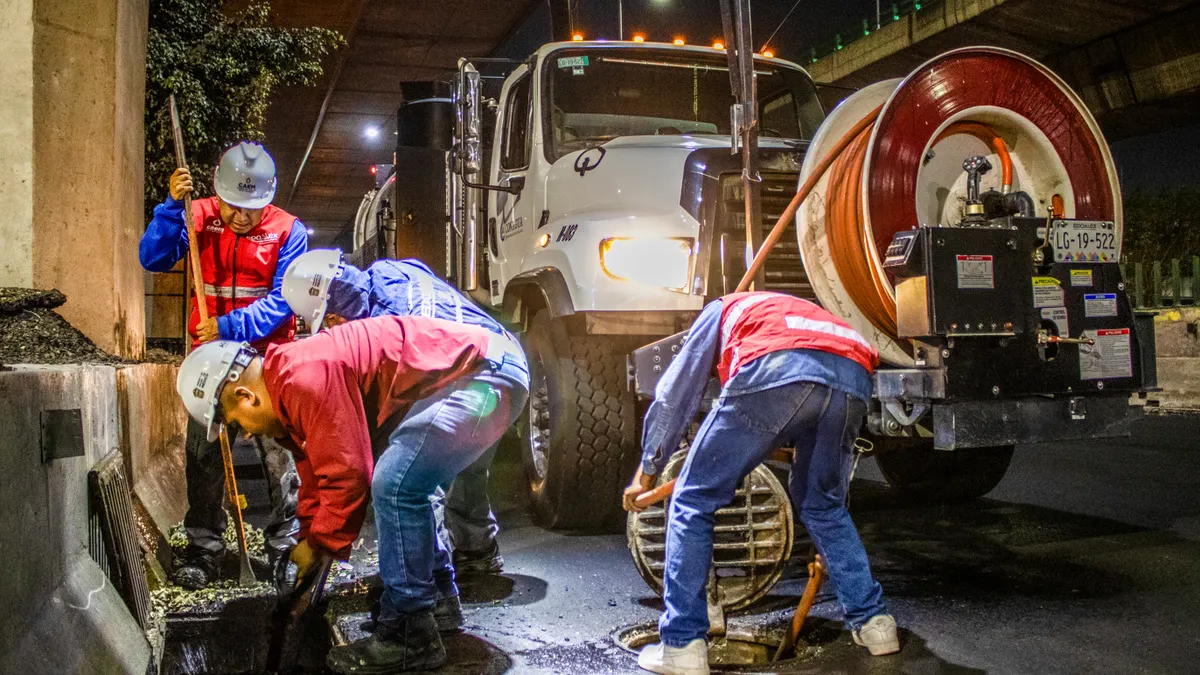
Check the street or nearest manhole if permitted
If the utility or municipality is involved, a street-side inspection can show whether the public main is surcharged or obstructed. -
Document everything
Photos, video, timestamps, and notes matter for insurance, landlord-tenant issues, utility claims, and repair records.
The strongest professional tracing is boring in the best way: it follows the pipe, not the story. A camera image of a broken clay joint beats a theory about “old plumbing” every time. A water level at the cleanout beats a guess. A neighbor with the same symptom pattern changes the diagnosis.
There is one limitation worth stating plainly. Not every sewer failure can be traced cleanly on the first visit. Intermittent blockages, partially collapsed lines, and surcharging mains can behave differently hour by hour. Heavy rainfall can mask or trigger symptoms. That is why a single dry-day check may not settle the issue if the complaint only appears during storms.
When the cause changes the fix
The cause dictates the repair, and the repair dictates the cost, disruption, and risk of recurrence. A blockage that can be cleared is not the same thing as a broken line that must be replaced.
If the problem is grease or solids, the fix may be augering, hydro-jetting, or scheduled maintenance. That is the best-case scenario because the line itself may still be structurally sound. The downside is recurrence if the habits that created the buildup stay the same. Wipes, grease, and “flushable” products keep causing the same issue.
If the problem is roots, mechanical cutting may restore flow, but recurring root growth often means the pipe has openings that let roots in. In that case, the real fix is spot repair, lining, or replacement of the damaged section. Cutting roots without addressing the entry point is a temporary cure.
If the problem is a collapsed or offset pipe, the fix is structural. No cleaning tool repairs a missing pipe wall. A trenchless lining may work in some cases, but severe collapse, misalignment, or crushed sections usually need excavation or a more extensive replacement.
If the problem is a municipal surcharge, the homeowner may need documentation and a claim path, not just a plumber. The utility may need to inspect the main, and the building owner still needs immediate cleanup and perhaps a backwater prevention strategy. That is a painful distinction because the damage is private even when the cause is public.
If the problem is venting, the correction is usually targeted and less invasive than a sewer repair. But a vent issue can make fixtures misbehave; it usually does not create true sewage rising from floor drains unless another blockage is also present.
This is where a lot of advice goes wrong. It treats every backup as a plumbing emergency with the same solution. A plunger, a snake, and a disinfectant bucket do not solve structural failure. They may temporarily mask it.
Exception scenarios that change the verdict
Sometimes the usual pattern flips, and the first suspect is wrong. These cases deserve a different approach.
1) Heavy rain starts the problem across the neighborhood
If several houses back up after a storm, the municipal main or combined sewer system moves up the list. In that case, call the utility first, document the timing, and still protect your property immediately.
2) The backup happens only at one fixture and nowhere else
That points away from a whole-house sewer obstruction and toward the fixture trap, branch line, or vent. A full sewer-line inspection may be unnecessary at first if the symptom is truly isolated.
3) The building has a grinder pump, ejector pit, or lift system
That changes the tracing logic. A failed pump, alarm issue, float problem, or power loss can mimic a sewer backup. The relevant component may be a pump system rated for specific head height or duty cycle, not the gravity sewer itself.
4) The property has a backwater valve or one-way check device
A failed or stuck valve can create odd symptoms, including partial backups or repeated overflows. A valve can solve one problem and create another if it is not maintained. If the valve has not been inspected in a while, it becomes a suspect instead of a side note.
These exceptions matter because they prevent wasted labor. A generic “roots in the sewer” answer misses pump failures, isolated fixture problems, and backwater device issues. The right trace depends on the system in front of you.
What should I do first after a sewage backup?
Stop using all drains, protect people from exposure, and call the right tracing pro based on the pattern. That is the shortest safe answer.
Begin with containment:
- Keep children and pets away from the area.
- Avoid walking through visible wastewater.
- Turn off the water use that could add more flow.
- Photograph the damage before cleanup if it is safe to do so.
- If the backup is active, call a licensed plumber or sewer specialist right away.
If the backup is in a basement or lower level, it can spread fast because gravity keeps sending flow to the lowest point. A floor drain that overflows during a toilet flush is a clue and a hazard at the same time.
If multiple homes on the block are affected, contact the municipality or utility. Many sewer departments have reporting lines for backups, blockages, or manhole overflow. That report can help establish whether the issue is public or private.
For cleanup and exposure concerns, the CDC and EPA both advise caution around contaminated areas. Sewage can carry pathogens, and the cleanup method depends on how long the area was wet, what materials were affected, and whether porous finishes were saturated. Drywall, insulation, carpet pad, and unfinished wood often need removal if they were contaminated.
Do not treat the cleanup as the first task if the source is still active. Tracing and stopping the inflow come first. Cleaning a floor while the line is still surcharging is like mopping under a leaking ceiling.
The verdict: what to trace first and when to stop guessing
Choose a private-line diagnosis if the backup stays in one home, begins at the lowest fixtures, or follows normal household use. Choose a municipal investigation if multiple nearby properties fail together, the timing matches heavy rain, or the street sewer shows signs of surcharge. Neither approach works if the line is still actively overflowing and nobody has stopped water use or called a licensed professional.
The cleanest decision rule is this: one property, one likely pipe; many properties, one possible public main. If the symptom pattern does not fit either, suspect pumps, valves, or a venting problem before tearing up pipe. And if the building has a collapsed line or active sewage in living space, do not keep tracing alone—stop use, document the damage, and bring in the appropriate professional immediately.
A sewage backup is a tracing problem before it is a cleanup problem. Get the source right, and the fix usually gets simpler. Get it wrong, and the same mess comes back.
Drafted with AI; not yet reviewed by a person.